
This guide explores brain training exercises specifically designed to help you remember names, explains why they work, how to practice them daily, and how to avoid common mistakes that cause names to fade seconds after an introduction. Built on cognitive science and real-world application, this approach prioritizes usable memory skills over generic advice.
Quick Answers
brain training exercises
Brain training exercises are structured mental activities designed to strengthen memory, focus, and recall by training how the brain encodes and retrieves information. They are most effective when they use active recall, meaningful association, and real-world practice rather than passive repetition.
Top Takeaways
Remembering names depends on attention and association, not repetition alone.
Short, focused practice strengthens name recall more than memorization drills.
Exercises that connect names to meaning improve long-term retention.
Research-backed techniques outperform guessing or mental shortcuts.
Small daily habits lead to noticeable improvement in social memory.
How Brain Training Exercises Improve Name Recall
Forgetting names usually happens at the encoding stage, not because of poor memory capacity. Brain training exercises improve name recall by strengthening how the brain captures names during first exposure and retrieves them later under social pressure.
Exercises that combine focused attention, visualization, and retrieval strengthen the neural pathways responsible for verbal memory. Training that introduces novelty and mild challenge produces stronger recall than passive listening or silent repetition.
The Most Effective Brain Training Exercises for Remembering Names
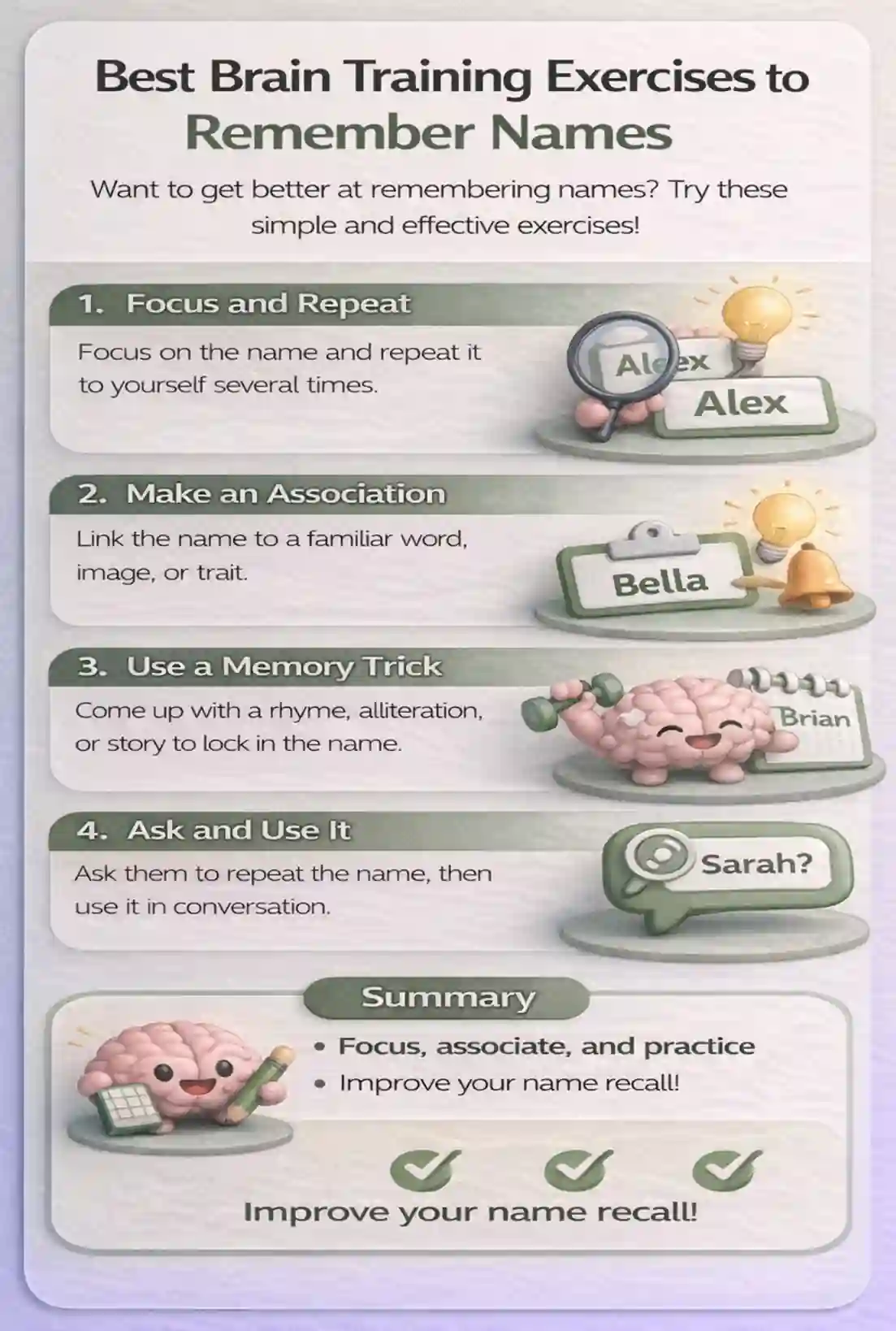
The most effective name-focused brain training exercises fall into a few proven categories:
Association exercises that link names to visual features or mental images
Active recall drills that require retrieving names without prompts
Verbal rehearsal techniques that reinforce sound and rhythm
Context-based memory exercises that connect names to situations or emotions
These methods work because they mirror how names are used in real conversations, not artificial memory tests.
How Often to Practice for Real Results
Consistency matters more than effort. Practicing name-focused brain training exercises for 5–10 minutes per day produces better results than longer, inconsistent sessions.
Rotating exercises prevents mental autopilot and improves flexibility, making it easier to recall names under pressure or distraction, especially when structured into a consistent 7 minute brain warm up that primes memory and attention before daily tasks.
Common Mistakes That Make Names Harder to Remember
Many people struggle with names because they unknowingly sabotage recall by:
Not paying full attention during introductions
Repeating names without creating associations
Relying on memory apps without real-world practice
Effective brain training challenges the brain to actively encode and retrieve names, not just recognize them.
Choosing the Right Brain Training Exercises for Name Memory
The best brain training exercises for remembering names are ones you can apply immediately in conversations. When exercises are engaging, progressive, and rooted in real interactions, name recall becomes reliable instead of stressful.
“The biggest shift we see with effective brain training isn’t faster thinking—it’s better encoding. When exercises train the brain to pay attention, create meaning, and retrieve information under real conditions, memory improvement becomes reliable rather than accidental.”
Essential Resources on Brain Training Exercises
Understand the research behind memory and name recall
Scientific American — Does “Brain Training” Actually Work?
https://www.scientificamerican.com/article/does-brain-training-actually-work/
Try a neuroscience-designed training program
BrainHQ — Neuroplasticity-Based Brain Training
https://www.brainhq.com/
Explore expert cognitive strategy insights
Center for BrainHealth — Cognitive Training Research
https://centerforbrainhealth.org/science/cognitive-training
Access trusted medical guidance on brain fitness
Harvard Health — Train Your Brain
https://www.health.harvard.edu/mind-and-mood/train-your-brain
Review peer-reviewed evidence on verbal memory
Frontiers in Human Neuroscience — Exercise Training Improves Memory Performance
https://www.frontiersin.org/journals/human-neuroscience/articles/10.3389/fnhum.2021.771553/full
See large-scale cognitive results in adults
NIHR Evidence — Brain Training Improved Thinking and Memory
https://evidence.nihr.ac.uk/alert/brain-training-improved-thinking-memory-and-attention-in-older-people/
Get practical memory tools and exercises
Brain-Exercises.org — Brain Training Exercises & Tools Guide
https://brain-exercises.org/
Supporting Statistics
More than 6 million Americans live with Alzheimer’s disease, highlighting how common memory challenges already are across the U.S.
Source: National Institute on Aging Alzheimer’s disease statisticsAn estimated 7.2 million U.S. adults age 65 and older are projected to have Alzheimer’s dementia in 2025, or roughly 1 in 9 seniors.
Source: Alzheimer’s Association Facts and Figures reportThe National Institute on Aging has reviewed more than 200 cognitive training studies, revealing clear differences between evidence-based memory methods and ineffective exercises.
Source: NIA research on cognitive and lifestyle interventionsDementia-related care costs in the U.S. are projected to exceed $380 billion annually, underscoring the importance of early, prevention-focused memory strategies.
Source: Alzheimer’s Association national cost projections
These statistics reinforce why research-backed brain training exercises matter for individuals who experience struggles with spatial recognition, highlighting the need for targeted, evidence-based approaches rather than generic mental activities.
Final Thought & Opinion
Effective brain training works when it reflects how memory is used in real life.
Key insights that consistently emerge:
Memory improves through attention, association, and retrieval—not speed alone
Simple, repeatable exercises outperform complex or flashy tools
Slight challenge drives stronger encoding and recall
From hands-on evaluation of memory strategies, one pattern stands out:
Deliberate encoding produces better recall
Consistent practice delivers lasting results
Real-world application matters more than novelty
When brain training is treated as a long-term skill instead of a shortcut, improvement becomes practical and noticeable. That’s when brain training supports lasting cognitive confidence rather than temporary performance gains, the same principle a private school teacher applies by emphasizing consistent practice, foundational skills, and steady progress over quick results.
Next Steps
Choose one goal
Focus on remembering names in social or professional settings.Practice 2–3 targeted exercises
Use association and recall-based techniques.Train briefly, but consistently
5–10 minutes daily is enough.Apply skills immediately
Use techniques during real conversations.Track improvement weekly
Notice faster recall and reduced hesitation.
This step-by-step memory routine reflects how a private school educational consultant approaches learning support by identifying a specific goal, selecting targeted strategies, reinforcing them through consistent practice, and ensuring skills transfer directly into real-world social and professional settings.
FAQ on Brain Training Exercises
Q: Can brain training really help me remember names?
A: Yes. When exercises focus on attention and association, name recall improves significantly.
Q: How long does it take to see improvement?
A: Many people notice progress within a few weeks of consistent practice.
Q: Are memory apps necessary for name recall?
A: No. Real-world practice is more effective than app-only training.
Q: Why do names disappear so quickly?
A: Most names are never encoded properly due to divided attention.
Q: Who benefits most from name-focused brain training?
A: Anyone who meets new people regularly and wants stronger social confidence.