
Bank statements, grant agreements, and the gift letters behind your restricted funds are usually enough to start outsourcing your nonprofit's accounting, even when the ledger is months behind. Reconciling and recoding come later. Your outsourced team handles that work during onboarding, which means most organizations need far less cleanup up front than their leaders expect.
Plenty of executive directors and board treasurers stall here anyway. Maybe a scholarship gift landed in the general fund, or last year's Form 990 went out on extension. Nobody wants an outside team to see that.
Accounting outsourcing means contracting your accounting and financial controls to an outside provider, and any team that specializes in outsourced accounting for nonprofits has seen books in worse shape than yours. So the useful question is which level of cleanup your organization needs, and who should handle each piece of it.
TL;DR Quick Answers
Outsourced Accounting for Nonprofits
Outsourced accounting for nonprofits means an outside team runs your bookkeeping, monthly close, fund tracking, and board reporting so your staff can stay focused on the mission. You don't need clean books to start, because a good partner fixes the foundation during onboarding.
What it covers: Reconciliations, grant and restricted fund tracking, functional expense splits, month-end close, board reports, and audit and Form 990 support.
What you need first: Bank and card statements, grant agreements, and records of donor restrictions.
Who handles cleanup: The outsourced team, usually as the first phase of the engagement.
Which level fits: Bookkeeping for clean, timely records; outsourced accounting for grant reporting and audit coordination; a fractional CFO for forecasting and board-level strategy.
When it makes sense: When grant reporting, restricted funds, or audit requests have outgrown a part-time bookkeeper or volunteer treasurer.
Top Takeaways
You can outsource once your records can be explained, even if they're still messy.
Cleanup usually falls into one of three levels: a light tune-up, a moderate catch-up, or a full rebuild.
Your job is supplying documents, access, and donor intent, and the partner handles reconciling and recoding.
Unreconciled months, blended restricted funds, or a late Form 990 just mean cleanup comes first.
Waiting until you feel ready makes the backlog bigger.
What "Clean Enough" Means Before You Outsource
A provider needs evidence, and the finished work can come later. Have these ready before your first call:
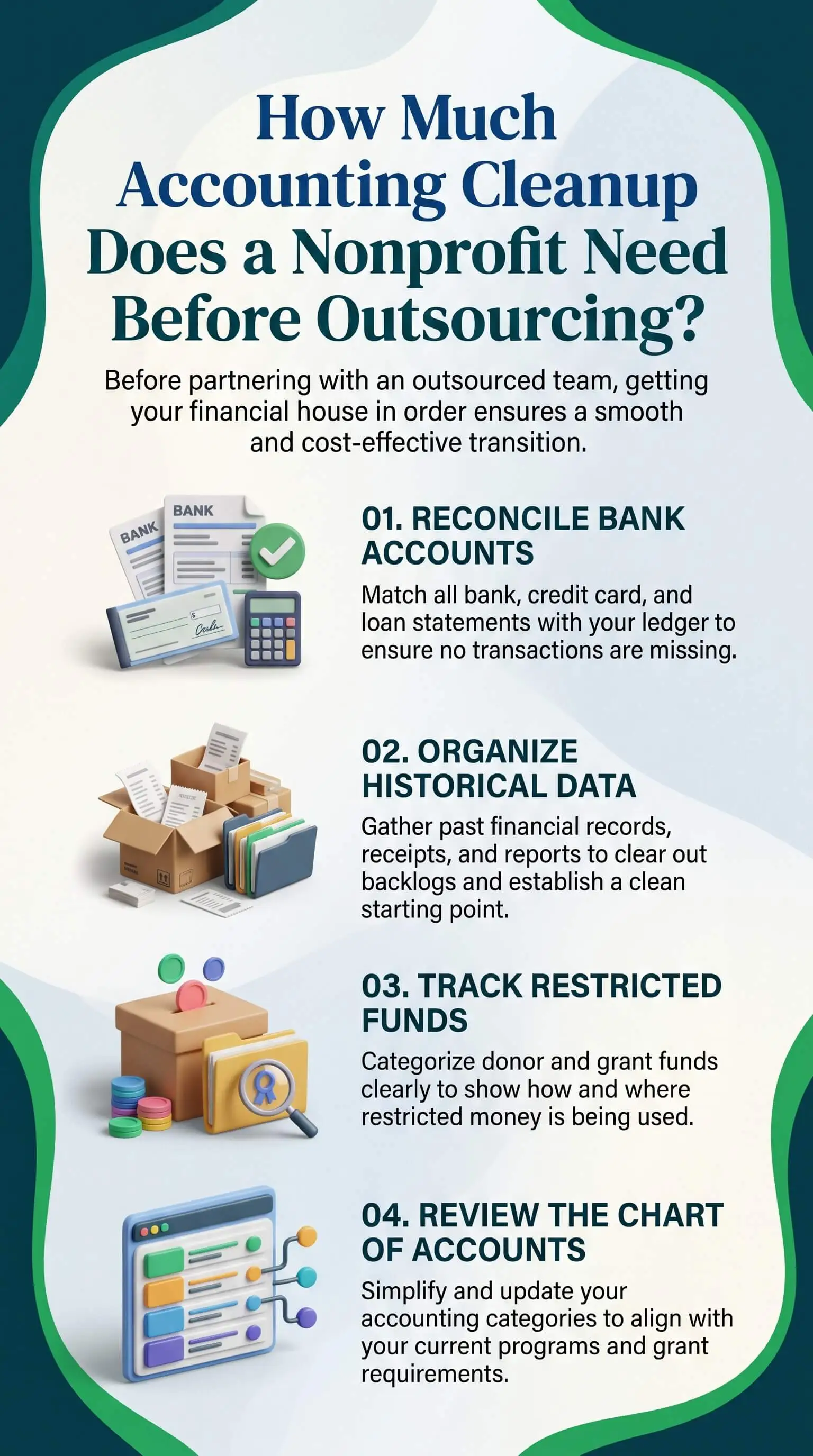
Bank and credit card statements for every account, including the dormant one nobody checks
Your current chart of accounts, even if it's cluttered
Gift letters, pledge forms, and any emails where a donor set terms
Signed grant agreements and their reporting deadlines
Payroll records and a login for your payroll provider
Your most recent Form 990, plus any audit report or management letter
You won't see finished reconciliations or a tidy balance sheet on that list, because producing those is the job you're hiring a partner to do.
Three Levels of Nonprofit Accounting Cleanup
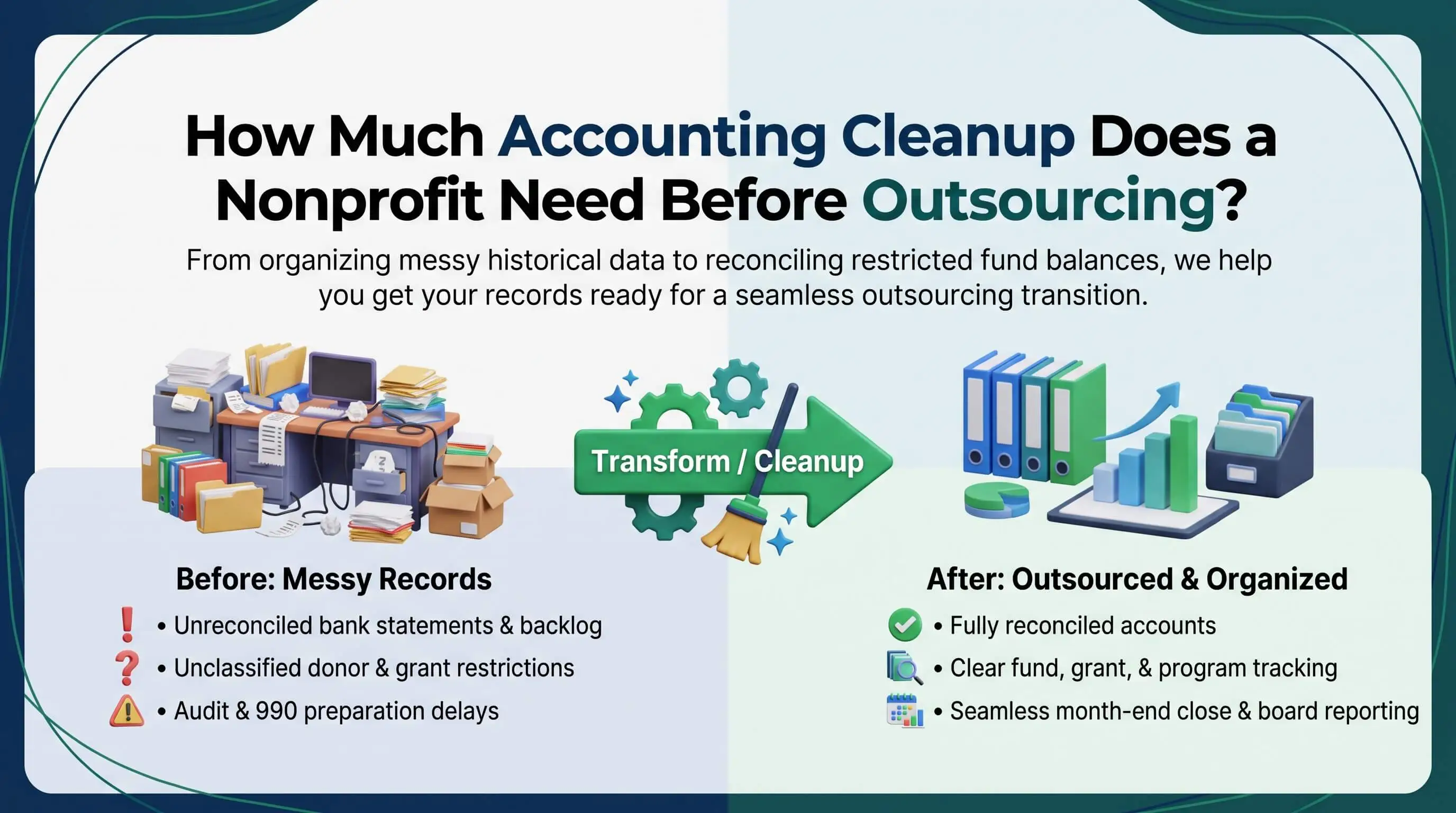
Cleanup means correcting, completing, and reconciling past records until today's reports can be trusted. Where your organization lands depends on how far behind the books are and how tangled the funds have become.
Light tune-up. The books are current within a month or two, with a few unreconciled accounts and some miscoding. Your outsourced team handles it during the first monthly close, so onboarding feels like a normal month with extra review.
Moderate catch-up. You're several months behind, restricted and unrestricted money has blended together, and nobody has split expenses by function. The outsourced team runs a defined catch-up project while you confirm donor intent and grant terms, and regular monthly service starts once it's done.
Full rebuild. The books are a year or more behind, or the 990 is missing, the auditor flagged findings, or nobody trusts the opening balances. A senior accountant or fractional CFO usually leads this work with the board involved, and the team reconstructs balances before building anything new on top of them.
Many organizations land somewhere in the middle tier. Be candid about your level on the first call, because it drives both scope and cost.
What You Fix vs. What an Outsourced Accounting Partner Fixes
You own the facts only your organization knows, and your partner owns the accounting.
Your nonprofit handles:
Pulling statements, agreements, and gift records together
Granting access to banking, payroll, and donor systems
Confirming what donors intended for each restricted gift
Getting board sign-off on policies and reserves
Naming one person on staff as the point of contact
Your partner handles:
Bank and card reconciliations
Reclassifying miscoded transactions
Coding by fund, grant, and program
Syncing donation platforms to your ledger
Splitting expenses across program, administration, and fundraising
Cleaning up opening balances and the chart of accounts
A good provider of outsourced accounting for nonprofits fixes the foundation during onboarding, so reconciliations and fund cleanup happen on their side of the table. Be wary of a firm that asks for reconciled books before it will start.
Red Flags That Mean Cleanup Comes First
A few problems need attention before routine monthly service can work:
Bank accounts that haven't been reconciled in three months or more
An undeposited funds balance that grows every month
Grant spending you can't trace back to a specific grant
A late Form 990, or one on extension with no plan behind it
Auditor management-letter comments that nobody resolved
One person who receives, records, and deposits all the cash
Any of these means your first phase is cleanup, and you can still outsource.
What This Looks Like for Education Nonprofits
School foundations, booster clubs, tutoring programs, and scholarship funds tend to share a pattern. Grants and restricted gifts make up much of their revenue, and volunteer treasurers often rotate out every year or two. Their fiscal year usually follows the school calendar too, which pushes the heaviest fundraising right up against year-end.
Restricted fund tracking is where these groups slip most often. One scholarship gift booked as general revenue can distort a full year of board reports. Education consultants who advise these groups run into the same issue, and many see real value in partnering with nonprofit accounting services.
A Pre-Outsourcing Checklist
Most teams can finish this in a week:
List every bank, credit card, and payment platform your organization uses.
Download 12 months of statements for each one, or go back as far as the books are behind.
Pull every active grant agreement and note when each report is due.
Gather gift letters and pledge forms for restricted donations.
Find your last filed Form 990 and your most recent audit or review.
Confirm logins for your accounting software, donor database, and payroll access.
Write down the problems you already know about, like duplicate entries, missing months, or a bookkeeper who left without notice.
Note upcoming audits, board meetings, and grant report dates.
Choose one person on staff to be the provider's contact.
Ask your board treasurer to join the first call.
"When a nonprofit tells us its books aren't ready, we start by asking for bank statements, grant agreements, and gift letters, because those show what actually happened. A clean ledger can wait. In our onboarding work, transaction volume is rarely what slows things down. The harder cases are restricted gifts that were never labeled and expenses that were never tied to a program, and we can fix both once we have the paperwork. Organizations that wait until they feel ready usually just end up with an older backlog."
7 Essential Resources
IRS: About Form 990. The official page for the form, every schedule, and the current instructions. Go here first if your return is late or you aren't sure which schedules apply.
IRS: Annual Exempt Organization Return, Who Must File. Shows whether you file a 990, a 990-EZ, or the 990-N e-Postcard, and lists the exceptions.
Journal of Accountancy: Simplifying FASB's Not-for-Profit Reporting Standard. Walk through ASU 2016-14, including the two net asset classes and the functional expense reporting your books need to support.
National Council of Nonprofits: Internal Controls for Nonprofits. Practical safeguards a small staff can put in place, like having a second person review bank statements.
Nonprofit Risk Management Center: Outsourcing the Finance or Accounting Function. Questions to ask a provider before you sign, and how to keep oversight once you do.
Accountix: Tracking Designated and Restricted Funds. Explains how restricted, unrestricted, and board-designated money differ, which is the cleanup issue that comes up most.
Accountix: Nonprofit Accounting Glossary for Leaders and Boards. CPA-reviewed, plain-English definitions for the terms you'll hear during cleanup.
3 Statistics
52% of nonprofits have three months of cash or less. Nonprofit Finance Fund's 2025 State of the Nonprofit Sector Survey found that 18% have a month or less. With margins that thin, leaders need books that show how much is actually spendable, which a bank balance alone can't tell them. Source: Nonprofit Finance Fund
90% of surveyed CFOs outsource at least some accounting work. Personiv's 2024 CFO Pulse survey of 278 U.S. finance leaders shows how ordinary outsourcing has become across industries. Source: Personiv via Business Wire
Accounting bachelor's graduates fell 7.8% in 2022. That AICPA figure, cited in coverage of the Personiv report, helps explain why small nonprofits have trouble hiring and keeping qualified finance staff. Source: NYSSCPA
Final Thoughts and Opinion
I think cleanup belongs at the start of a good outsourcing relationship, as the first thing the partner delivers.
Wanting to tidy up first makes sense. Nobody likes the idea of a stranger opening a messy ledger. But a volunteer treasurer working evenings won't untangle a year of blended restricted funds faster than a team that does this every month, and each month you wait is one more month someone has to reconcile.
A simpler test works better. If you can hand over your statements and grant terms and name someone who will answer questions, you're ready to talk about outsourced accounting for nonprofits, whatever the books look like today.
One caution, though. Outsourcing doesn't take oversight off your board's plate, and only your organization can say what a donor meant. The right partner gives you audit-ready books and reports your board can trust, along with a clear record of every correction the team made.
Frequently Asked Questions
Do our books need to be perfect before we outsource?
No. A provider needs bank and card statements, grant agreements, records of donor restrictions, and access to your systems. Reconciling accounts, recoding transactions, and sorting out fund balances are normally part of what an outsourced team does in the first weeks of the engagement.
Does outsourced accounting for nonprofits include cleanup work?
Often, yes. Many firms run catch-up work as the opening phase and then move into regular monthly service. Before you sign, ask how the firm scopes cleanup, who on its team does the work, and how it documents the corrections.
How long does nonprofit bookkeeping cleanup take?
That depends on how far behind you are and how complete your records are. A light tune-up can fit inside the first monthly close, while a moderate catch-up or full rebuild is usually scoped as a separate project. Expect an estimate after the provider has reviewed your records.
What documents should we gather before talking to a provider?
Start with statements for every bank, card, and payment account, then add active grant agreements, gift letters or pledge forms for restricted donations, payroll records, your last filed Form 990, and any audit report or management letter. For nonprofits supporting education programs, include financial records related to school teacher salaries and program expenses. A short written list of known problems saves time on the first call.
Can we outsource if our Form 990 is late or under extension?
Yes, and a late return is a good reason to bring in help sooner. Share your filing status and deadlines on the first call so the team can plan cleanup around the return. Under federal law, an organization that doesn't file for three consecutive years loses its tax-exempt status automatically.
Will cleanup change our past financial statements?
It can. Cleanup may reclassify transactions or correct balances from earlier periods. If you've had an audit or review, your provider should work with your auditor on how to record and disclose corrections, so the board can see exactly what changed and why.
CTA
Not Sure Which Cleanup Level Fits?
Gather your statements, grant agreements, and gift letters, then talk with Accountix about where your books stand. A 30-minute intro call is enough to map the cleanup, who owns each piece, and how soon you can get back to focusing on your mission. No obligation, just clarity.


