
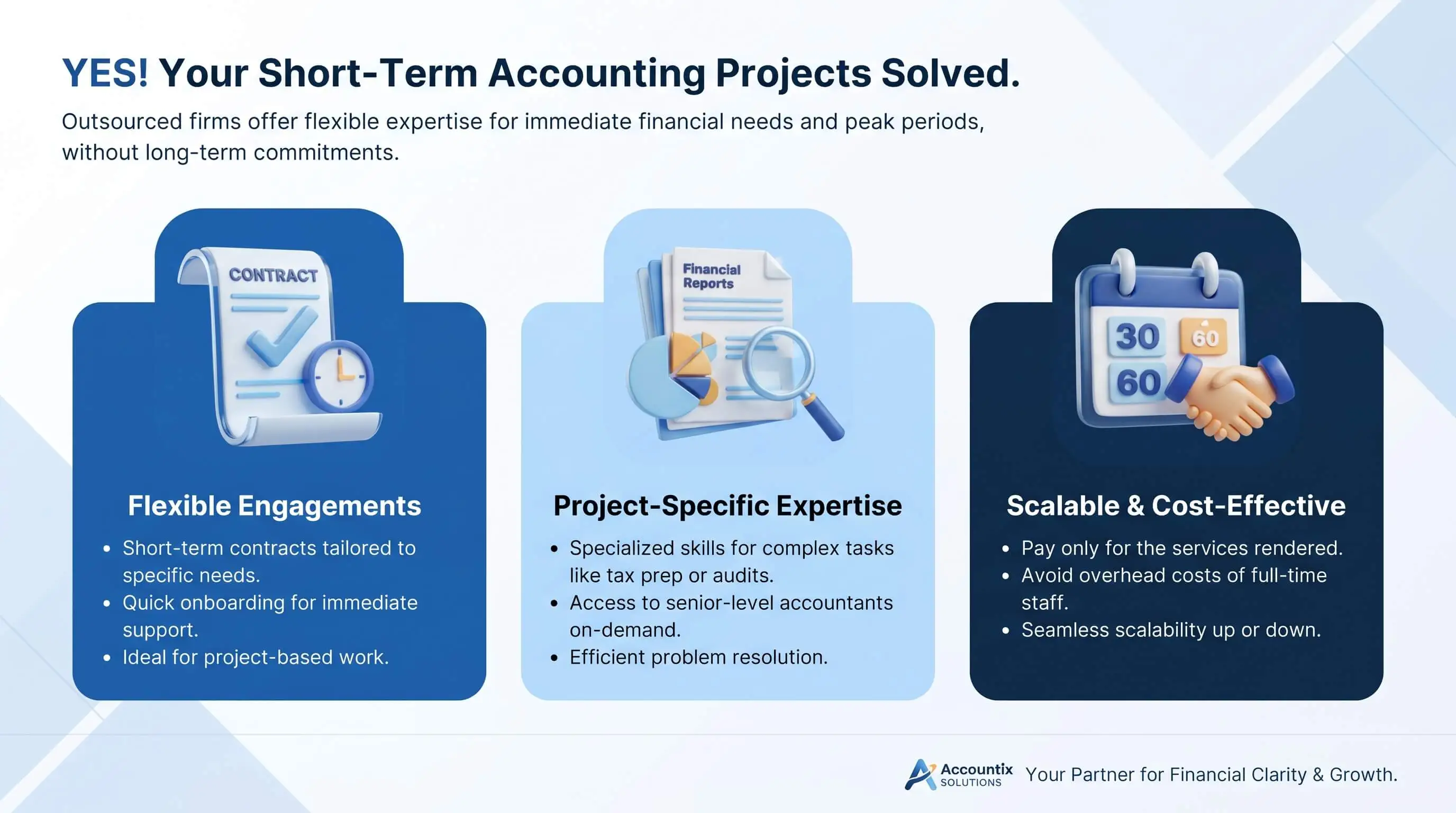
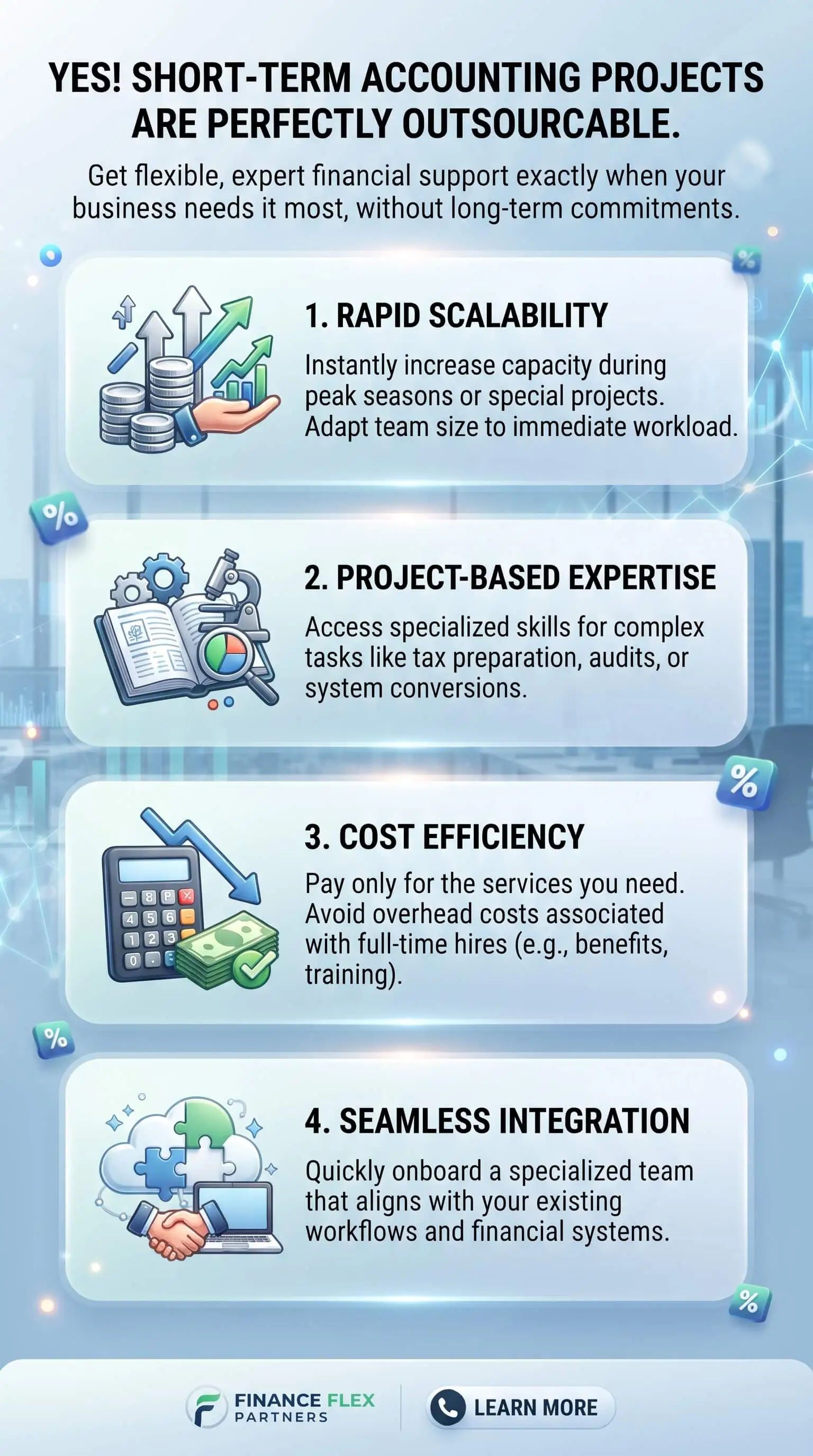
Yes, you can. An outsourced accounting firm will take on a short-term project, and for most small organizations it's the quickest way to get experienced help without adding someone to payroll.
The situations tend to look alike. Your books are six months behind. Or an audit just landed on the calendar, or your bookkeeper gave notice right before your busy season, or you need new accounting software in place before things get hectic. Each one has a finish line, and none of them automatically calls for a new hire.
When you hire an outsourced accounting firm for a project, you bring in people who've done this exact kind of work before. You agree on what "done" means up front. They get you there, and afterward you decide whether you need anything more.
TL;DR Quick Answers
Hire Outsourced Accounting Firm
To hire an outsourced accounting firm, define the outcome you need, ask for a fixed price after a discovery call, and confirm that a controller or CPA reviews the work. A good firm will also tell you when you don't need it.
Start with the outcome: clean books by a set date, audit-ready records or a finished software migration.
Get a fixed scope, not an hourly meter: the firm should look at your books before it names a price.
Check who reviews the work: layered expertise (bookkeeper, controller and CPA) catches errors a solo freelancer can miss.
Confirm it works with your CPA: the firm keeps your books in order, and your tax preparer still files the returns.
Expect candor about fit: sometimes the right answer is a part-time bookkeeper, and a trustworthy firm will say so.
Plan the hand-off: agree on what you receive at the end and how the firm's access gets shut off.
Top Takeaways
You can hire an outsourced accounting firm for a single, defined project.
Cleanups, year-end close, audit prep and software migrations fit best.
A firm gives you a built-in review, which most freelancers and temp hires don't.
Ask for a fixed fee or capped scope once the firm has seen your books.
Before work begins, agree on the hand-off and on what happens if the project shows an ongoing need.
What Does an Outsourced Accounting Firm Do on a Short-Term Basis?
Accounting outsourcing means handing your accounting to an outside provider instead of an in-house team. Most people picture a standing monthly arrangement. The same firms also take on defined work with a clear start and end.
That work comes in two kinds. Transaction work is the routine that has to be right every time: payables, receivables, payroll entries and bank reconciliations. Knowledge work is where judgment comes in, such as budgeting, forecasting and setting up internal controls.
Most short-term projects need some of both. That's a big reason a firm offering outsourced bookkeeping services with layered expertise, usually a bookkeeper, a controller and a CPA, handles them well. Nobody on the team has to be good at everything, and someone senior checks the work before it comes back to you.
Short-Term Accounting Projects That Are a Good Fit
These are the projects that most often make sense to hand to an outside team:
Books cleanup and catch-up: reconciling months of unrecorded or miscategorized transactions.
Year-end close: getting your accounts in order before your tax preparer starts.
Audit or financial review prep: pulling together schedules, supporting documents and reconciliations.
Software migration: moving to QuickBooks Online or connecting tools like Bill.com, Gusto or Ramp.
Grant or donor reporting: getting restricted-fund reports out on deadline.
Vacancy or leave coverage: keeping the monthly close on schedule while you hire.
Budget season: building a budget and cash forecast you can actually work from.
Due diligence: cleaning up your finances before a loan application, investment or sale.
Education organizations run into these more often than you'd expect. A private school may need audit-ready books before the board's annual review. An independent education consultant might have a year of mixed business transactions to untangle before applying for financing and may benefit from fractional CFO services. And a tutoring company that wants its accounting system rebuilt has to do it before enrollment season, because nobody will have time once it starts.
Outsourced Firm, Temp Hire or Freelancer: Which Fits Your Project?
Any of these can work. They start at different speeds and bill in different ways, and only some of them come with a second set of eyes on the work.
Outsourced accounting firm: usually starts within weeks, once a discovery call is done. A controller or CPA reviews the work, and you pay a fixed fee, a project fee or a retainer. It suits projects that need several skill levels and a reliable finish.
Interim staffing agency: can place someone in days to weeks. Your own team supervises that person at an hourly bill rate, which works when you need to fill a seat inside an existing finance team.
Freelance accountant: can often start fast, though that depends on the person. Pricing is hourly or per project, there's often no second reviewer, and the fit is small, well-defined tasks.
Temporary in-house hire: often takes months to fill. You pay salary plus recruiting and onboarding costs, and your own team supervises. For a short project, it's rarely worth it.
Oversight is the difference that matters most. A good freelancer can do excellent work, but if they make a mistake, there's often nobody checking. A firm with review built into its process catches problems before they reach your tax return or your board. And as BDO points out, hiring permanent staff for a short-term need brings recruiting and training costs you may never get back.
What Does It Cost to Hire an Outsourced Accounting Firm for a Project?
Firms usually bill hourly, by the project, or on a weekly or monthly retainer. For a defined project, ask for a fixed fee or a capped scope. You'll know the price before work begins, and the firm has every reason to scope the job carefully.
So what moves the price? Mostly how far behind or disorganized your books are, how many accounts and systems the work touches, and how much judgment it takes. Catching up three months on a single bank account costs far less than audit prep across several entities. If someone quotes you a firm price before they've looked at your books, be cautious.
How to Hire an Outsourced Accounting Firm for a Short-Term Project
Write down the outcome and the deadline. Be specific, for example: "All 2026 accounts reconciled and ready for the tax preparer by February 15."
List what's involved. Include your bank and credit card accounts, your software, your payroll provider and any documents the firm will need.
Ask for a fixed scope after discovery. A good firm looks at your books before it names a price.
Find out who does the work and who reviews it. Ask whether a controller or CPA signs off before anything comes back to you.
Settle data access and the hand-off. Decide how you'll share logins and shut them off, and what you'll receive when the project ends.
Decide what happens next. Agree now on how you'll handle it if the project shows you need ongoing help.
A good firm will walk you through all of this without pushing. Accountix, an outsourced accounting firm based in Santa Barbara, starts with a short intro call, moves into discovery, and then sets a fixed price instead of billing by the hour. On a project, that order matters, because you and the firm settle the scope before any clock starts running. The Accountix team also works alongside your existing CPA or tax preparer rather than replacing them.
When a Short-Term Project Turns Into an Ongoing Need
One honest caveat. A cleanup project often shows why the books got messy in the first place. Maybe nobody owns the month-end close. Maybe receipts never get matched to transactions. If you clear the backlog without fixing the process, you'll probably need another cleanup next year.
That doesn't mean you have to sign up for more. When the project wraps, ask the firm what it found and what it would recommend. A trustworthy firm will tell you when you don't need it, and sometimes the right answer is a part-time bookkeeper. If you do need ongoing help, staying with the team that already knows your books spares you a second onboarding.
"When a business comes to us with a deadline, say an audit in six weeks or a lender asking for clean financials, we start by writing down what it looks like. Then we tell the client what we found along the way, even when it isn't what they hoped to hear. In our experience, a clear scope keeps the work on track. Candor is what makes the client trust the numbers afterward."
7 Essential Resources
U.S. Bureau of Labor Statistics: Accountants and Auditors: what accountants do, how they train, and where demand for them is heading.
U.S. Chamber of Commerce: Signs You Should Outsource Your Small Business Accounting: the warning signs that it's time to bring in outside help.
U.S. Chamber of Commerce: A Guide to Outsourcing Accounting Tasks: which accounting tasks you can hand off, and how to pick a partner for them.
BDO: Interim Staffing Resources for Special Projects: how organizations staff urgent, time-limited finance projects.
Deloitte: 1Q 2025 CFO Signals Survey: how finance chiefs are responding to the shortage of accountants.
CPA Practice Advisor: 87% of Finance Leaders Report a Critical Talent Shortage: survey findings on open roles and hiring pressure.
Thomson Reuters: Senior Accountants Are Now Corporate America's Toughest Finance Hire: how long finance roles take to fill, and how often companies outsource instead.
3 Statistics
About 124,200 openings for accountants and auditors will come up each year from 2024 to 2034, the U.S. Bureau of Labor Statistics projects. Many of them come from people retiring or changing careers, so qualified help stays hard to find.
94% of finance leaders say they use outsourcing to fill open accounting positions, according to a 2026 survey reported by Thomson Reuters.
17 open accounting and finance roles was the average per company in 2026, up from five in 2025 and two in 2024, Accounting Today reports.
These statistics highlight the growing shortage of accounting professionals and the increasing reliance on outsourced accounting services, allowing organizations such as private schools to focus their recruitment efforts on private school teacher jobs while maintaining reliable financial operations.
Final Thoughts and Opinion
I think short-term outsourcing is one of the most underused options a small organization has. Too many owners and administrators try to push through a backlog on their own, or they start a months-long search for someone they only need for one season. Neither is a good use of their time.
The projects that go well share two habits. The finish line goes on paper before work starts. And the firm is honest about what it finds. Hire an outsourced accounting firm that does both, and you'll come away with more than a finished project: you'll know whether your books need more attention, and you'll make your next decision with real numbers in front of you.
Frequently Asked Questions
Can I hire an outsourced accounting firm for just one project?
Yes. Many firms will take on a defined project, like a book cleanup, a year-end close or audit prep, as long as the scope and deadline are clear. On the first call, ask whether they take project work and how they wrap up an engagement.
How long does a short-term accounting project usually take?
Most run from a few weeks to a few months. A small catch-up can wrap in weeks. Audit prep or a software migration across several accounts takes longer. What matters most is the state of your books and how quickly you can get documents to the firm.
Is an outsourced accounting firm cheaper than hiring a temporary accountant?
Often, yes, once you count recruiting, onboarding and the time you'd spend supervising. A temporary hire also brings one person's skills. A firm brings several levels of expertise plus a second reviewer. For short, defined work, a fixed-fee project usually costs less overall.
What should be in the scope of work for a short-term accounting project?
The outcome and deadline, the accounts and systems involved, who does the work and who reviews it, the price, and what you get at the end. It should also spell out how you and the firm will handle and price any changes to the scope.
Will an outsourced accounting firm work with my existing CPA or tax preparer?
A good one will. Many outsourced accounting firms keep your books in order and coordinate with your outside CPA or tax preparer, who still handles the returns. Confirm this in your first conversation so everyone knows who owns what.
What happens to my financial data when the project ends?
You should get your updated books, reconciliations and any reports in the format you agreed on, and the firm should give up its access. Ask about data security and how they close out a project before you sign.
Have a Project With a Deadline? Start With a Conversation
If your books are behind, an audit is coming up, or your accounting is stuck between people, you don't have to sort it out alone. Book a short intro call with an outsourced accounting team to discuss your financial needs, including outsourced family office executive services. Walk them through what needs to get done and by when, and get a clear scope and price before any work begins.
No obligation, just clarity.


